
Temporary Import Malaysia: Stop Paying Dead Taxes
Imagine buying a house just so you can sleep in it for a three-week vacation, only to abandon it when you fly home.
Financially, that makes zero sense. Yet, this is exactly what foreign contractors, engineering firms, and specialized manufacturing facilities do every month at Port Klang and Penang Airport. They bring in highly specialized, multi-million-Ringgit machinery or customer equipment for a short-term project and pay the full Import Duty (often up to 20%) and Sales and Service Tax (10%). That is hundreds of thousands of Ringgit permanently wiped from their margins just to "borrow" or "fix" an item.
The Malaysian Customs framework offers a powerful bypass valve for this exact scenario. However, to execute it without having your cargo detained, you must deeply understand the overall temporary import procedure and the strict temporary import requirements that govern it.
Executing a temporary import is like opening a bank vault—you have to turn two completely different keys at the same time: The Tax Facility (avoiding the bill) and The Import Permit (passing the border bouncers).
Key 1: The Tax Facility (The "Security Deposit" Rule)
Taxes are designed to be paid on goods permanently consumed in the local economy. A temporary import for re export shouldn't be taxed because the item is only visiting.
However, you can't just promise Customs that you will take the goods back out. You have to prove it with a security deposit—usually a Bank Guarantee for one-off shipments or a General Bond for high-volume facilities. If you successfully export the equipment when you are done, the guarantee is returned. If you overstay, Customs simply cashes it.
To legally request this arrangement, you must apply under the correct exemption frameworks:
Item 33 (Butiran 33) & Section 97: "Look, But Don't Touch" (Exhibitions & Trade Shows)
Item 33 (frequently referred to in local customs terminology as Butiran 33) is strictly for displaying goods.
However, think of a temporary import as passing through two separate toll booths at the Malaysian border. Item 33 only gives you a free pass for the Sales Tax (SST). To get past the Import Duty toll booth, you must simultaneously apply Section 97 of the Customs Act 1967, which is the master law for suspending import duties on temporary imports.
The Scenario: A foreign robotics manufacturer needs a temporary import for trade show display in Kuala Lumpur.
The Execution: Your forwarding agent declares both Section 97 (to suspend Import Duty) and Butiran 33 (to suspend SST). The suspended amounts from both taxes are added together, and you must lock up that exact combined total in a Bank Guarantee. Whether it is a temporary import for exhibition or a temporary import for demonstration, the machinery can be powered on to show how it works, but it cannot be used for commercial production. Once the convention ends, it gets repacked and shipped out, and Customs returns your Bank Guarantee.
Item 34 (Butiran 34) & Section 97: The "In and Out Hospital" (Professional Use, Testing & Repairs)
This is the workhorse exemption, and it is absolutely critical for the aviation, engineering, and semiconductor sectors.
Scenario A: The MRO Facility (The Hospital)
An aerospace MRO facility in Selangor receives a commercial aircraft engine from Singapore that requires a heavy overhaul. This is a classic temporary import for repair and return.The Execution: The MRO does not pay permanent taxes. They combine Item 34—or Butiran 34 in the Malay legal text—(for SST exemption) and Section 97 of the Customs Act 1967 (for Import Duty exemption). Because they handle high volumes of a temporary import for repair, they secure the taxes with a General Bond instead of a single Bank Guarantee.
Scenario B: The Semiconductor Equipment Specialist (The Traveling Surgeon)
To upgrade or troubleshoot a multi-million-dollar wafer testing machine, a Penang-based semiconductor plant (OSAT) brings in a specialized engineering contractor from Europe. The contractor needs to bring in highly sensitive, proprietary optical calibration rigs and cleanroom diagnostic servers for a 4-month upgrading project.The Execution: Even if the local semiconductor plant has Licensed Manufacturing Warehouse (LMW) status, standard machinery exemptions do not cover a third-party contractor's own equipment that will ultimately leave the country. Instead, the foreign contractor relies purely on Butiran 34 for a temporary import for testing. They provide the commercial invoice, the project contract, and a Bank Guarantee. The diagnostic tools clear customs tax-free, the testing and calibration are completed, and the equipment is shipped back out.
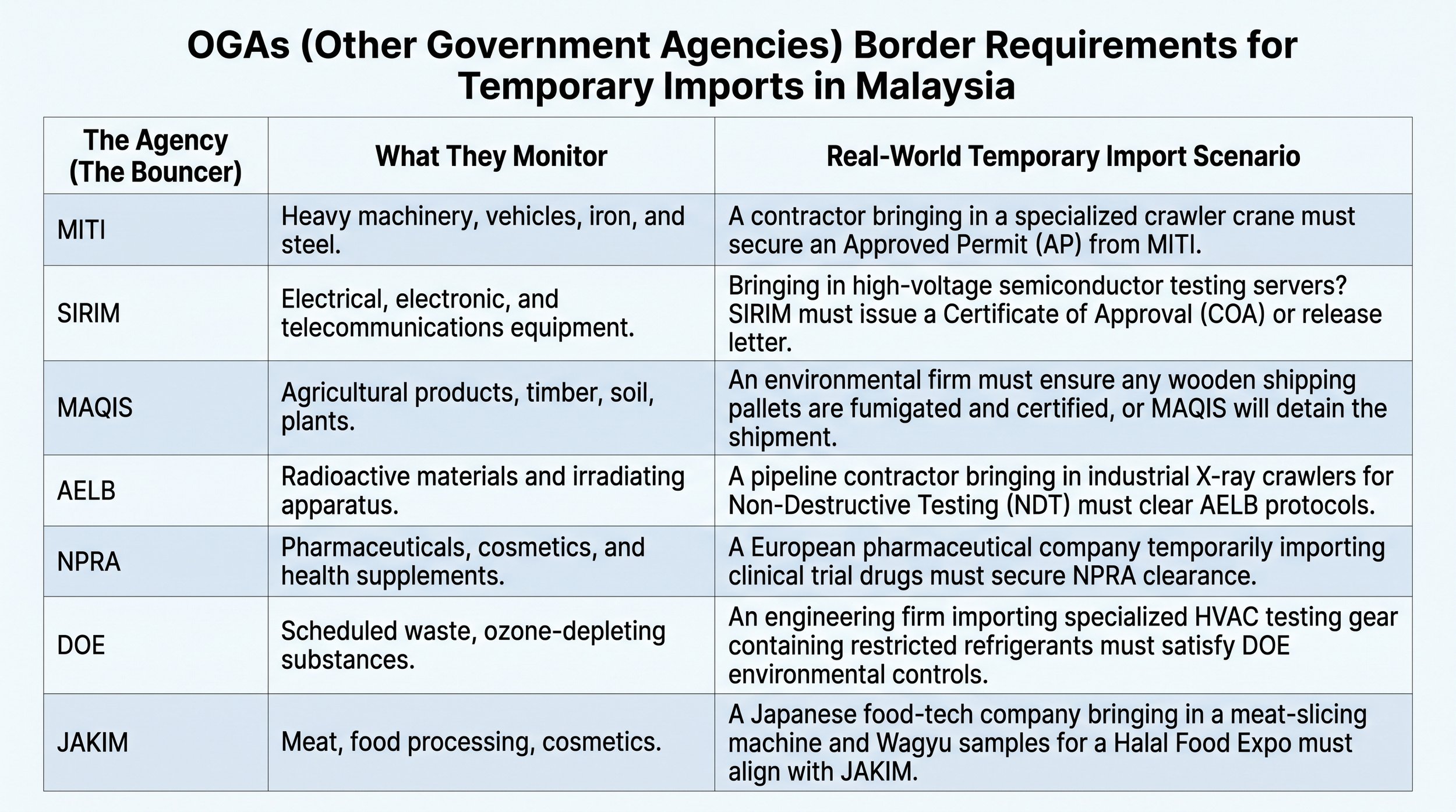
Key 2: The Temporary Import Permit Requirements (The "VIP Bouncers")
Here is the most common trap that destroys project timelines: Businesses assume that because Customs approved their tax exemption, their cargo is free to enter the country.
Tax exemption is not border clearance.
Getting your taxes waived is like getting free entry to an exclusive club. But if you show up carrying hazardous materials or unauthorized tech, the bouncer at the door is still going to deny you entry. You must satisfy specific temporary import permit requirements issued by Other Government Agencies (OGAs) before the ship arrives.
The Enforcement Reality: How to Close the Loop
Customs officers are not interested in your business intent; they strictly follow the paper trail. If the paperwork doesn't close perfectly, the penalty is automatic.
The 3-Month Window: Temporary imports are generally granted an initial validity period of 3 months.
Proactive Extensions: Engineering projects and cleanroom calibrations frequently delay. You must apply for an extension from the State Director of Customs before your current window expires.
The Exit Strategy & CPC Codes: You cannot simply put the diagnostic tools on a plane and assume Customs knows they left. The physical goods must be presented to Customs at the port of exit, and declared using a Customs Form K2. Crucially, your forwarding agent must declare the exact temporary import for repair cpc (Customs Procedure Code) in the Customs declaration system. Declaring the wrong CPC code will cause the system to reject the export closure, leaving your Bank Guarantee trapped.
Align the temporary import tax facility to protect your cash flow, ensure your forwarding agent secures the OGA permits to clear the border, and rigorously track your expiry dates and CPC codes. That is how you execute a flawless temporary import.
Stop Guessing. Secure Your Margins with Expert Customs Consulting
Navigating Butiran 33, Butiran 34, and Customs Bank Guarantees shouldn't be a trial-and-error process that risks your cash flow.
While your forwarding agent handles the physical OGA border permits, structuring the underlying tax exemption with Royal Malaysian Customs is where your true financial exposure lies.
At Baryk Partners, our customs consulting service is led by a former Royal Malaysian Customs Department Senior Officer with over a decade of frontline enforcement and compliance experience. We don't just guess what Customs wants to see—we know exactly how to structure your temporary import facility to satisfy regulatory requirements.
Whether you need to structure a temporary tax exemption for a short-term engineering project, a trade show exhibition, or a high-volume MRO engine repair cycle, we handle the technical customs compliance so you can focus on the job.
Contact Baryk Partners today to secure your tax exemptions, manage your Bank Guarantees, and keep your equipment moving without paying "dead taxes."
Phone / WhatsApp: +6012 628 0798
Email: hktee@barykpartners.com
Website: www.barykpartners.com
