
Free Trade Agreement (FTA) Malaysia: Stop Bleeding Profit Margins
Many manufacturing businesses across the Klang Valley and beyond are quietly bleeding profit margins every time they import raw materials. They accept full import duties as a fixed cost of doing business. Recently, a client's supply chain audit revealed just how expensive this assumption can be—we successfully recovered RM950,000 in raw material tax overpayments simply by restructuring their Harmonized System (HS) codes and leveraging the right trade agreements.
If you are importing or exporting goods, you need to understand how Free Trade Agreements (FTAs) actually work. We are going to deconstruct the complex legal jargon of Malaysian FTAs into pure, actionable mechanics so you can stop overpaying the Royal Malaysian Customs Department.
What is an FTA? (The VIP Club Analogy)
Let’s strip away the bureaucratic language. Think of global trade like a massive network of exclusive nightclubs.
Normally, when your goods arrive at a foreign port (or when foreign goods arrive in Port Klang), they have to pay a "cover charge" to get in. This cover charge is the import duty.
A Free Trade Agreement (FTA) is simply a VIP membership card agreed upon between two or more countries. If you hold this VIP card, your goods get to skip the standard cover charge and enter duty-free, or at a massively discounted rate.
But here is the catch: you don't get the VIP treatment just by showing up. You have to prove you actually belong to the club.
The 2026 Malaysian FTA Network
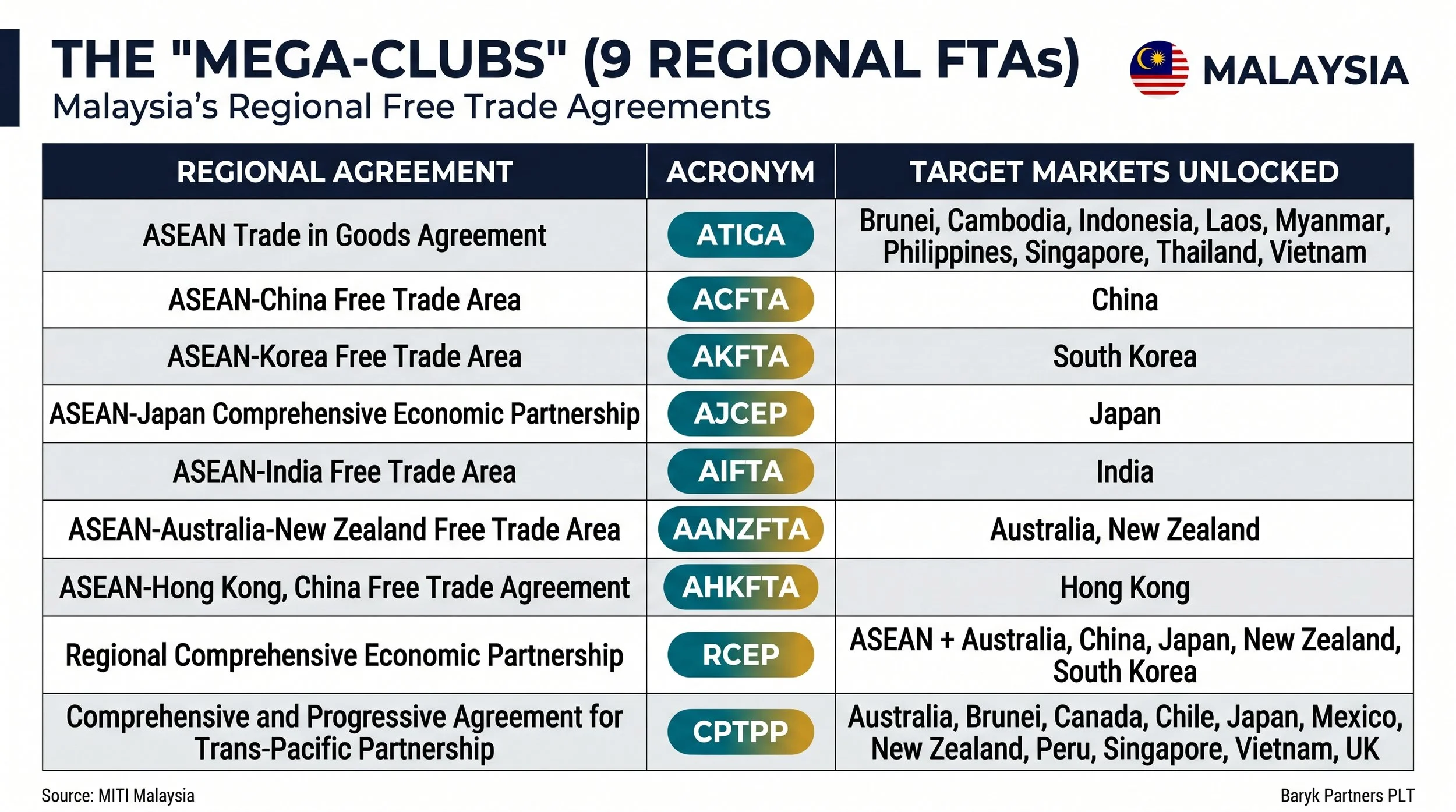
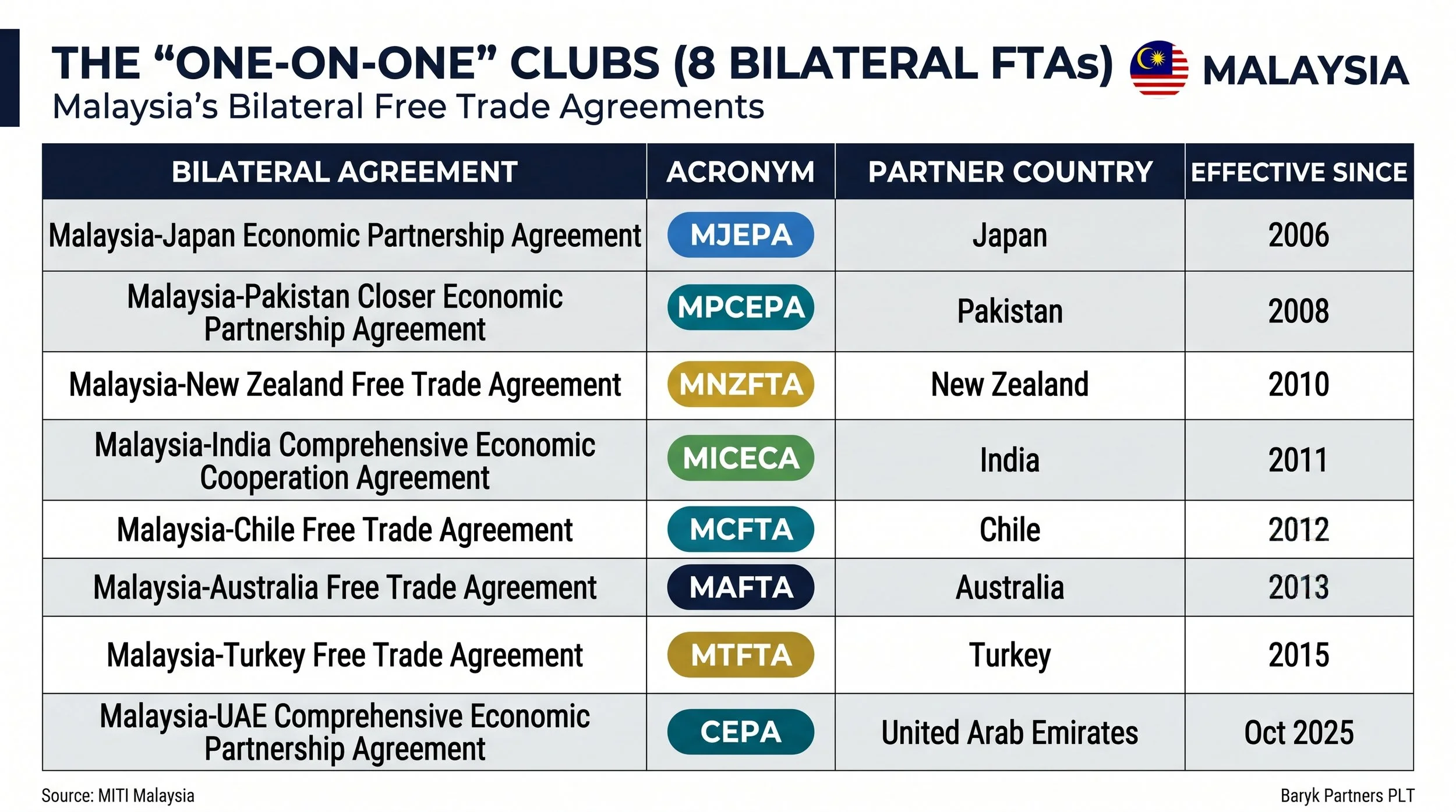
As of 2026, Malaysia holds one of the most robust VIP networks in the world, giving our manufacturers incredible leverage to source cheap raw materials and export competitively. Malaysia currently has 8 bilateral FTAs and 9 regional FTAs in force.
1. The "Mega-Clubs" (9 Regional FTAs)
These agreements give you access to massive multi-nation blocs. Using a regional FTA is like having a master key that works across multiple borders, provided you meet the bloc's collective Rules of Origin.
2. The "One-on-One" Clubs (8 Bilateral FTAs)
Bilateral agreements are direct pipelines between Malaysia and one specific country. Sometimes a bilateral agreement offers better margins, easier origin rules, or faster tariff elimination than its regional counterpart.
3. Signed, But Waiting at the Door
Note: An FTA being "signed" does not mean you can use it tomorrow. It must enter into force first.
Malaysia-EFTA Economic Partnership Agreement: Signed with Iceland, Liechtenstein, Norway, and Switzerland in June 2025, but pending ratification before manufacturers can claim preferential tariffs.
How to Choose When You Hold Multiple VIP Cards (The "Overlap" Strategy)
Here is where the game gets interesting for Malaysian manufacturers. Because Malaysia’s network is so dense, you often don't just have one VIP card—you have several.
Take Australia, for example. If you are exporting a manufactured good from your Selangor facility to Sydney, Malaysia actually shares four overlapping FTAs with Australia: MAFTA, AANZFTA, RCEP, and CPTPP.
You cannot use all of them at once. You must declare exactly one preferential route per shipment. You evaluate this using a simple three-part test:
The Duty Rate (The Margin Test): Check the specific tariff schedule for your product's HS code under each agreement. One agreement might reduce your buyer's import duty to 5%, while a newer one drops it entirely to 0%.
The "Bouncer" Difficulty (The Rules of Origin Test): The agreement with the 0% duty rate might have a very strict Rule of Origin, requiring a high percentage of local content. If your Bill of Materials (BOM) relies heavily on raw materials from outside the club, you might fail the test for that specific agreement. You then pivot to an overlapping agreement with a lower threshold.
Administrative Friction: Sometimes, older, well-established bilateral agreements have smoother, faster Cost Analysis (CA) approvals on the MITI ePCO system simply because customs officials are deeply familiar with the paperwork.
Never blindly assume the newest or biggest FTA is the best one for your specific product. You have to run the math on your Bill of Materials against the specific HS code rule for each overlapping agreement.
The Catch: The "Rules of Origin" (ROO) Bouncer
If you buy a product from China, slap a "Made in Malaysia" sticker on it, and try to export it to Australia under MAFTA, you will be rejected.
Why? Because of the Rules of Origin (ROO). The ROO is the bouncer at the VIP club.
The bouncer’s only job is to ensure the goods actually "originated" in the club member's country. To satisfy the ROO, your goods must either be wholly obtained in Malaysia (like agricultural products) or undergo a substantial transformation in your Malaysian manufacturing facility. If you are just repackaging goods, you don't qualify.
The Exporter's Playbook: 3 Steps to Give Your Buyer Duty-Free Access
You cannot just tell Customs you have an FTA. As an exporter, you have to trigger the mechanism mathematically and legally through the Ministry of Investment, Trade and Industry (MITI).
The HS Code Foundation: Everything in customs starts with the Harmonized System (HS) Code. If your raw material or finished product is classified incorrectly, your entire duty exemption strategy collapses. You must map the precise HS code of your imported raw materials against the HS code of your finished product.
The Cost Analysis (CA): You must prove to MITI that your product meets the Rules of Origin. This requires submitting a Cost Analysis report via the ePCO (Dagang Net) system, including your manufacturing license, raw material invoices, production flow charts, and the precise cost breakdown showing how much local value you added.
The Preferential Certificate of Origin (PCO): Once MITI approves your Cost Analysis, you must apply for a PCO for every export shipment. The PCO is the actual, physical VIP ticket that travels with your shipment. Without it, the importing country will charge full duties to your buyer.
The Importer’s Playbook: How to Skip the "Cover Charge" at Port Klang
What if you are on the receiving end? As a Malaysian importer, you can absolutely claim import duty exemptions (or reduced rates) under an FTA—but it does not happen automatically.
To skip or reduce the import duty "cover charge" when goods arrive in Malaysia, your shipment must meet four non-negotiable conditions:
The Origin Country is in the Club: You must be importing from a country that has an active FTA with Malaysia (like China under ACFTA, or Australia under MAFTA).
The Goods Pass the "Bouncer" (Rules of Origin): The goods cannot just be shipped from that country; they must actually be manufactured or grown there, meeting the specific Rules of Origin (ROO) for that agreement.
The Supplier Gives You the VIP Ticket: This is the most common point of failure. Your overseas supplier must apply for and send you a Preferential Certificate of Origin (PCO) (e.g., Form E from China, Form D from ASEAN) from their local government. If they do not send you this certificate, Malaysian Customs will charge you full duty.
Your Forwarder Declares It: Your Malaysian customs forwarding agent must declare the specific FTA and submit the Certificate of Origin to the Royal Malaysian Customs Department at the time of import clearance.
Immediate Action Step for Importers: If you are placing an order with an overseas supplier, you must explicitly state in your Purchase Order: "Supplier must provide a Preferential Certificate of Origin (COO) for FTA duty exemption." If you do not ask for it, they will not arrange it, and you will pay full price at Port Klang.
Stop Guessing with Your Profit Margins. Let’s Audit Your Customs Strategy.
A simple misclassification, a missed FTA overlap, or a supplier forgetting a Certificate of Origin could be costing your factory hundreds of thousands of Ringgit in unrecoverable taxes every year. Structural compliance isn't just about avoiding a Post-Clearance Audit (PASCA)—it’s the ultimate margin-preserver.
If you are ready to stop leaving money at the border and want to untangle your HS codes and optimize your FTA overlaps, we need to talk. Our team, led by a former Royal Malaysian Customs Department Senior Officer, knows exactly how the system works from the inside out.
Book a Confidential Customs Compliance Audit with Baryk Partners today:
📞 Direct Advisory Line / WhatsApp: +6012-628 0798
✉️ Email: hktee@barykpartners.com
🌐 Website: www.barykpartners.com
Protect your margins. Secure your supply chain. We’ll show you exactly where the tax leaks are happening.
