
Manage an LMW Audit in Malaysia: Common Mistakes and Checklist
How to Manage an LMW Audit in Malaysia: Common Mistakes and Complete Preparation Checklist
Operating a Licensed Manufacturing Warehouse (LMW) in Malaysia offers significant cash-flow advantages by suspending import duties and sales tax on raw materials, components, and machinery. However, that fiscal relief comes with strict statutory accountability. Under Malaysian customs law, tax exemption is never an outright gift; it is a conditional loan. If your inventory records show even a slight discrepancy, the law presumes those goods were unlawfully diverted into the local market.
Understanding the core principles and origins of LMW audit oversight requires looking back to the legislative reforms of 1972. Sections 65 and 65A of the Customs Act 1967 established LMWs to encourage export-oriented manufacturing across regional industrial corridors. To protect state revenue, the Royal Malaysian Customs Department (RMCD; Jabatan Kastam Diraja Malaysia) enforces stringent LMW audit checks to ensure duty-free materials are either exported as finished goods, legally cleared with tax paid, or accounted for as scrap.
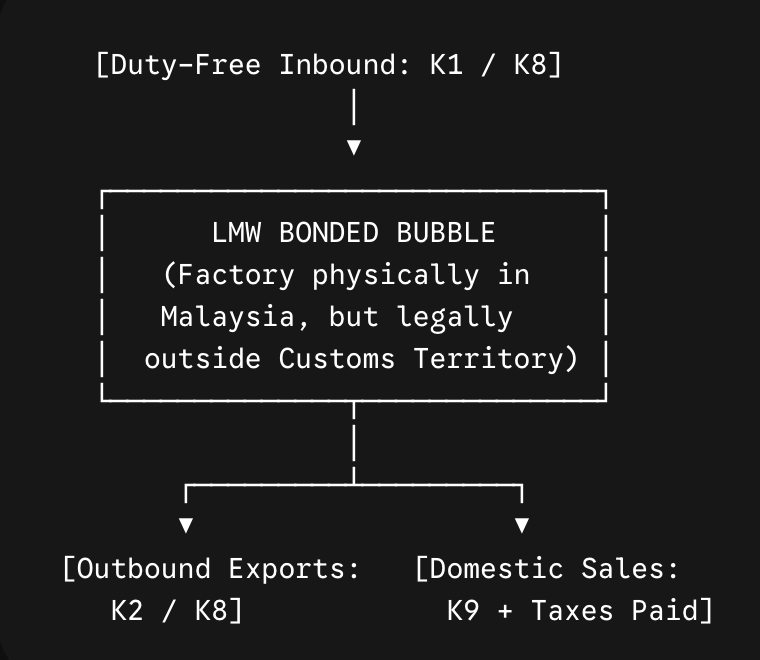
Explain What an LMW Audit Covers in Simple Terms
To understand how an LMW audit functions, imagine your factory is an island floating outside Malaysia’s customs borders. The government lets you bring in boatloads of raw materials without paying import duties or sales taxes. In exchange, the customs authority places an invisible gate at your factory door.
Customs applies a simple mathematical rule: the mass-balance principle. Think of it like baking bread:
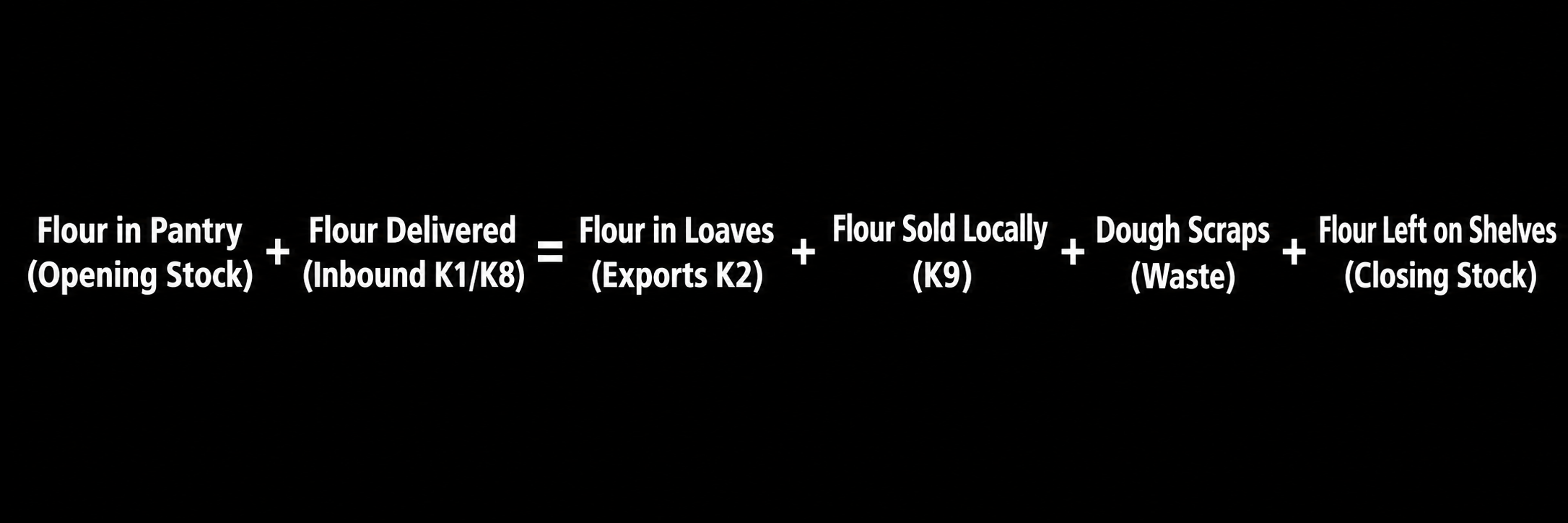
If you bought 1,000 kg of duty-free flour, baked 800 kg worth of bread for export, have 100 kg on the shelf, and swept up 50 kg of scrap, but cannot account for the remaining 50 kg, customs will not accept that the material simply vanished. Under Sections 65(4) and 65AB of the Customs Act 1967, any physical deficit creates an immediate statutory presumption that the missing 50 kg was smuggled into the local market. Customs will immediately assess back-duties and sales taxes via a formal Bill of Demand (BOD).
What Is an LMW Audit and Who Typically Performs Them?
An LMW audit is an official statutory examination of a licensed manufacturer’s physical inventory, production records, customs declarations, and accounting books to verify that all duty-exempt materials have been handled legally.
In Malaysia, these audits are administered by the Compliance Management Division (Bahagian Pengurusan Pematuhan) of the RMCD. Depending on the nature of the review, an LMW auditor may come from:
The District Customs Controlling Station (Stesen Kawalan): Performs routine desk audits and field inspections.
The Post-Clearance Audit Branch (Cawangan Audit Pasca Import / PCA): Conducts deep multi-year retrospective investigations.
Customs Enforcement / Investigation Division: Deployed when serious tax fraud or deliberate smuggling is suspected.
Structured Breakdown of LMW Audit Phases and Typology
Customs audits are categorized into distinct operational formats depending on administrative depth and risk targeting.
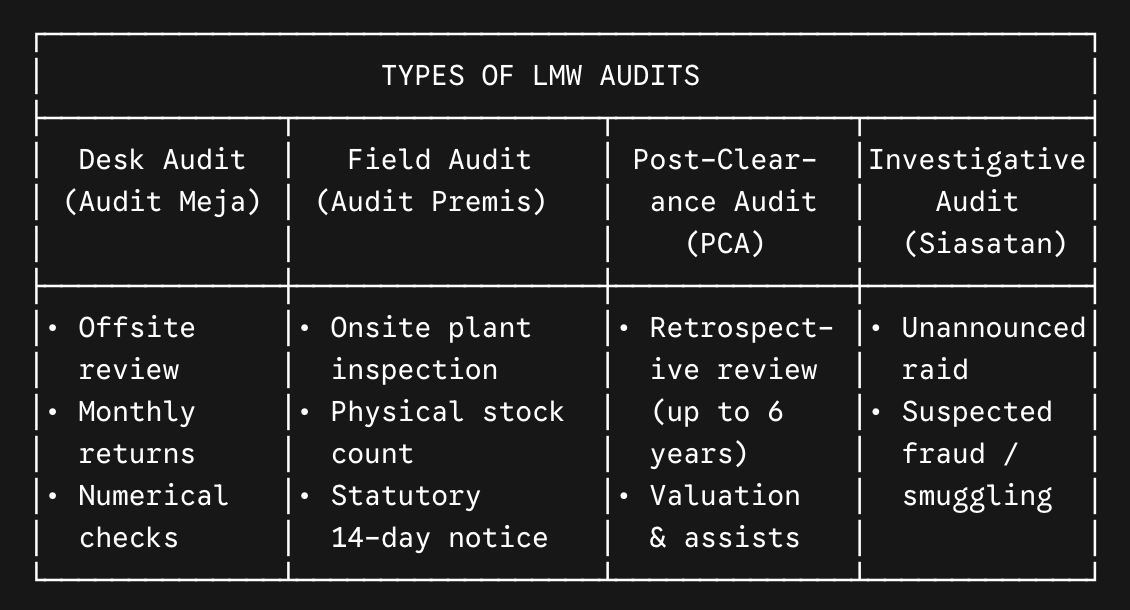
Desk Audit (Audit Meja): Routine verifications conducted directly at the local customs office. Officers cross-check submitted monthly statements (Lampiran M1, M2) against electronic filings in the customs system.
Field Audit (Audit Premis / Luar): Officers visit the production facility following a standard statutory notice of at least 14 days. They inspect physical boundary fences, reconcile raw materials and finished goods, and inspect production lines.
Post-Clearance Audit (PCA): A comprehensive historical audit examining transactions spanning up to six (6) years retrospectively under Section 100A(3) of the Customs Act 1967. PCA teams review customs valuation, tooling, overseas engineering assists, and royalties.
Investigation Audit (Audit Siasatan): Unannounced visits triggered by verified intelligence, whistleblowers, or severe discrepancies indicating deliberate duty evasion under Section 133 or 135.
What Triggers an LMW Audit?
Modern customs audits rely on automated risk parameters inside the Sistem Maklumat Kastam (SMK) and uCustoms, integrated with data from the Inland Revenue Board (LHDN) and the Companies Commission of Malaysia (SSM). Common triggers include:
Using residual "basket" tariff codes (HS Codes ending in "90") to claim duty exemptions without clear technical justification.
Inconsistencies between real-time electronic invoices and filed customs declarations.
Sudden fluctuations in scrap allowances that deviate from industry baselines or historical factory yield ratios.
Breaching the mandatory 80/20 export-to-local sales ratio within a rolling 12-month period.
Unreturned subcontracted inventory exceeding the 90-day statutory limit.
Operational milestones, such as LMW license renewals (every 1 to 2 years) or formal license surrenders and cancellations.
What an LMW Audit Detects in Financial and Operational Records
During an audit, customs inspectors reconcile operations across six critical areas:
1. Customs Declarations and Customs Valuation
Auditors compare shipping files, bank payment remittances, and import declarations (Customs Form K1). They ensure Cost, Insurance, and Freight (CIF) import values reflect reality. They look for hidden dutiable additions, such as:
Free or discounted production tooling, dies, and molds provided by foreign clients (engineering assists).
Direct royalties and license fees paid to overseas corporate parents that relate to the imported materials.
2. Statutory Periodic Reporting Timelines
Every LMW licensee must submit recurring compliance reports to their local controlling customs station:
Lampiran M1 (Monthly Raw Materials Statement): Reconciles opening balances, inbound receipts (K1/K8), materials issued to production, scrap generated, and closing inventory. Due by the 28th of each following month.
Lampiran M2 (Monthly Finished Goods Statement): Records quantities manufactured, outbound exports (K2/K8), domestic sales (K9), and physical stock. Due by the 28th of each following month.
Lampiran M4 (Annual Statutory Return): A 12-month reconciliation submitted alongside the company's external audited financial statements. Due by January 31 of the following year (or within 30 days of the financial year-end).
Lampiran H (Subcontracting Ledger): Tracks parts sent to domestic vendors, monitoring the return of goods against the 90-day window.
3. Production Yields and Input-Output Ratios (IOR)
When establishing an LMW, manufacturers register a formal Bill of Materials (BOM) detailing the exact ratio of duty-free raw materials needed to produce one finished unit. Auditors test this formula against physical floor yields. Discrepancies between theoretical ratios and real shop-floor consumption often reveal hidden losses, unapproved design changes, or scrap leaks.
4. Local Sales Quotas (The 80/20 Rule)
LMW facilities must export at least 80% of their total finished product output by value over a rolling 12-month window. Sales into the local Principal Customs Area (PCA) are restricted to a maximum of 20%. Any domestic sale requires:
Prior approval from MIDA and RMCD.
The filing of Customs Form K9 and full payment of import duties and sales tax before cargo leaves the factory gate.
5. Subcontracting Operations and the 90-Day Rule
Farming out production processes (such as stamping, heat treatment, or plating) requires written approval via Lampiran G1 and G2. Dispatched materials must be tracked under Lampiran H and physically return to the LMW premises within 90 calendar days. If parts remain at a vendor's premises on day 91 without an approved extension, customs treats the balance as an illegal domestic diversion under Section 135(1).
6. Capital Machinery and Factory Boundaries
The 10-Year Rule (Lampiran F): Machinery imported with duty exemptions remains under bonded surveillance for ten (10) years. Selling, moving, or scrapping machinery under 10 years old requires prior customs approval and the payment of residual taxes.
Premises Integrity (Lampiran C & Regulation 47): Licensees must comply with 26 physical security conditions, including permanent perimeter fencing, dedicated scrap enclosures, and partitioned raw material storage. Under Regulation 47 of the Customs Regulations 1977, modifying a plant layout, knocking down partition walls, or adding a warehouse without advance written customs approval violates your operating conditions.
7 Costly LMW Compliance Mistakes to Avoid
Relying on a Single "LMW Clerk": Leaving compliance entirely to one logistics clerk creates severe operational vulnerability. If that employee resigns, gaps in monthly filings and aging subcontract work can go unnoticed until auditors arrive.
Negative Inventory Balances in Stock Ledgers: Negative stock counts in an ERP system signal that production pulled untracked, duty-paid local materials or that customs filings (K1) lagged behind physical consumption. In an audit, this invalidates your mass-balance model.
Discarding Scrap Without Supervision: Production swarf, metal off-cuts, and chemical waste derived from duty-free inputs remain dutiable. Discarding or selling scrap without filing Customs Form K9—or destroying hazardous waste without customs officers present—exposes the business to severe penalties.
Failing to Reconcile Lampiran M4 with Audited Financials: When total revenue reported in corporate financial statements contradicts the production, domestic sales, and export values declared in annual Lampiran M4 returns, customs launches an immediate inquiry.
Overlooking Foreign Tooling and Engineering Assists in Customs Declarations: Calculating K1 import values purely from commercial invoice prices while omitting client-supplied molds, tooling, or software licenses leads to customs valuation penalties.
Ignoring the Subcontract 90-Day Clock: Consigning raw materials to third-party vendors without monitoring the return date can result in automatic compounding notices once the 90-day window expires.
Unapproved Factory Floor Modifications: Erecting temporary storage awnings or relocating internal partition walls without submitting updated architectural drawings violates Regulation 47 of the Customs Regulations 1977.
Step-by-Step Guide: The Ultimate LMW Audit Checklist
Use this structured LMW audit checklist to systematically review operational compliance across your organization.
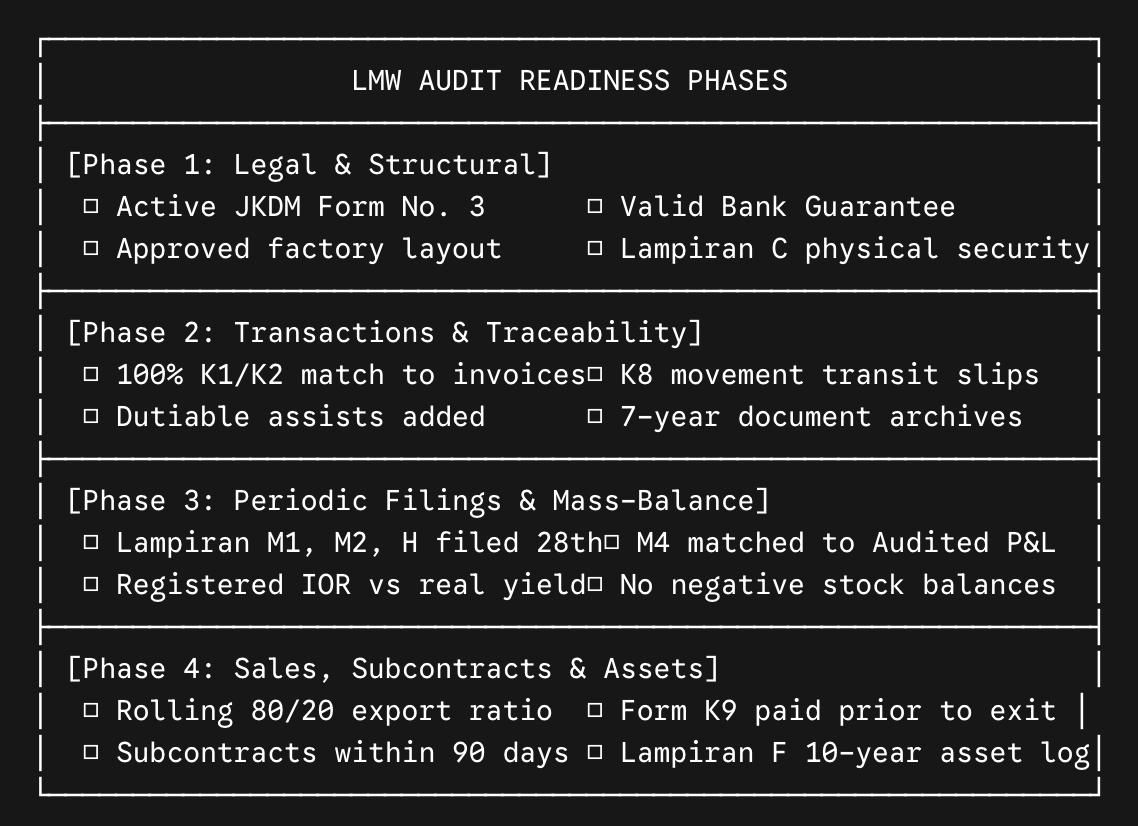
Phase 1: Licensing & Premises Verification
Confirm that your LMW License Certificate (JKDM Form No. 3) is current and displayed.
Verify that Bank Guarantees (Lampiran D) or General Bonds (Lampiran E) are active and cover current inventory risk.
Inspect perimeter fencing, security gates, and partitioned bonded storage areas to ensure compliance with the 26 conditions of Lampiran C.
Check that no structural building additions or partition shifts have occurred without written approval under Regulation 47.
Phase 2: Customs Declarations & Transaction Matching
Perform a three-way reconciliation matching purchase orders, invoices, and shipping documents to Customs Form K1 declarations.
Reconcile outbound export declarations (Customs Form K2) against outward gate passes, bills of lading, and foreign payments.
Verify that all inter-warehouse bond transfers (Customs Form K8) have complete receiving endorsements and proof of transit integrity.
Ensure all relevant shipping documents, physical logbooks, and declarations are safely archived for the mandatory 7-year retention period under Section 100A.
Phase 3: Reporting Cadence & Mass-Balance Alignment
Confirm that Lampiran M1 and M2 monthly returns carry official customs receipt stamps dated on or before the 28th of every month.
Reconcile your ERP Bill of Materials with the approved Input-Output Ratios registered with customs.
Conduct cyclical physical inventory counts to ensure physical stock matches book inventory, eliminating negative ledger balances.
Confirm that the annual Lampiran M4 return reconciles with figures reported in your independent external audited financial statements.
Phase 4: Local Quotas, Subcontracting & Asset Controls
Review your rolling 12-month sales ledger to confirm local sales do not exceed the approved 20% PCA threshold.
Verify that all local domestic removals are supported by approved Customs Form K9 declarations and official duty payment receipts.
Check the Lampiran H subcontract tracking register to confirm no materials have remained at vendor sites beyond 90 days.
Audit fixed assets against the Lampiran F machinery register, ensuring all duty-free equipment under 10 years old remains accounted for on the factory floor.
Confirm that all commercial scrap sales have paid duties via Form K9, and that unsellable waste has official supervised destruction certificates signed by RMCD officers.
How to Manage an Active Audit or Customs Investigation
When customs issues an audit notice or appears for an inspection, following a structured management plan helps safeguard company interests:
Step 1: Receipt of Notice (14-Day Window)
└─ Verify the statutory scope, dates, and names of assigned customs officers.
└─ Consolidate requested files: K-forms, monthly returns, ERP ledgers.
Step 2: Onsite Management & Verification
└─ Host officers in a dedicated conference room; assign a single corporate liaison.
└─ Accompany officers during plant floor tours and stock counts.
Step 3: Exit Conference & Reconciling Findings
└─ Request a detailed exit briefing to clarify noted discrepancies.
└─ Prepare written explanations supported by engineering yields and shipping manifests.
Step 4: Managing Disputed Findings (Administrative & Legal Redress)
└─ If an audit query letter (Surat Tunjuk Sebab) or Bill of Demand is issued:
• Evaluate voluntary disclosure options if errors were administrative.
• Lodge a formal appeal with the Customs Appeal Tribunal (CAT) within 30 days.
• Seek judicial review in the High Court of Malaya on legal interpretations.
Maintaining a compliant Licensed Manufacturing Warehouse requires viewing customs regulations as a continuous governance priority rather than a last-minute scramble. By maintaining accurate material traceability, aligning engineering yield ratios with customs filings, tracking subcontracted components, and running periodic internal reviews, businesses can protect their bonded status, avoid costly penalties, and operate with complete regulatory confidence.
Need Professional Support with LMW Audit?
Customs regulations and statutory mass-balance compliance leave zero margin for error. An unexpected discrepancy during an RMCD inspection can trigger immediate Bills of Demand, retrospective duty assessments, compounding fines, and disruptions to your bonded manufacturing status.
Our dedicated Customs and LMW advisory practice at Baryk Partners is led by a former senior Customs officer with over 10 years of direct frontline regulatory and audit experience. We provide end-to-end technical support to protect your operations before, during, and after a customs intervention:
Pre-Audit Health Checks & Mass-Balance Reconciliations: Auditing ERP raw material consumption, physical inventories, and registered Input-Output Ratios (IOR) to uncover and resolve yield discrepancies internally.
Statutory Reporting Remediation: Reviewing, correcting, and updating Lampiran M1, M2, and Lampiran H filings, alongside annual Lampiran M4 alignments with audited corporate financials.
Subcontracting & Asset Regularization: Auditing vendor aging against the 90-day statutory threshold and reconciling Lampiran F machinery registers.
Audit Representation & Dispute Defense: Managing technical inquiries, responding to formal query letters (Surat Tunjuk Sebab), and defending against adverse Bill of Demand (BOD) assessments before the Royal Malaysian Customs Department.
Ensure your LMW bonded facility is fully audit-ready and protected against regulatory liabilities.
Phone / WhatsApp: +6012 628 0798
Email: hktee@barykpartners.com
Website: https://www.barykpartners.com
