
MIDA Manufacturing License in Malaysia (2026): Requirements, Formulas & How to Apply
If you have ever downloaded a government PDF on setting up a factory in Malaysia, you have probably stared at terms like ICA 1975, CIPE, MTS Index, and NIF and wondered if you need a corporate lawyer just to assemble a product.
You don't. You just need someone to translate the rules into plain English.
By breaking complex regulations down into everyday analogies and simple math, this guide walks you through everything you need to know about the MIDA manufacturing license in Malaysia: who needs it, how to pass the hidden math tests, how to apply online, and the expensive traps that trip up first-time applicants.
1. What Is a MIDA Manufacturing License?
Imagine you start making chili oil in your kitchen and selling jars to friends. Nobody bothers you. Now imagine your chili oil goes viral. You lease a massive industrial warehouse, buy automated bottling machines, and hire 90 people to run two shifts.
At that scale, you are no longer a home business—you are part of the national economy. The government wants to ensure your factory operates safely, uses modern equipment, hires locals, and fits into Malaysia's long-term industrial plan.
That is what the MIDA manufacturing license is: a federal permit to run a large-scale manufacturing operation in Malaysia.
It is enforced under the Industrial Co-ordination Act 1975 (ICA 1975) and administered by MIDA (the Malaysian Investment Development Authority), an agency under the Ministry of Investment, Trade and Industry (MITI).
What counts as "manufacturing"?
Under Section 2 of the ICA 1975, manufacturing does not just mean smelting steel or building cars. It is defined broadly as making, altering, blending, ornamenting, finishing, or treating any article or substance for use, sale, transport, delivery, or disposal—including the assembly of parts.
2. Do You Actually Need One? (The "Either/Or" Rule)
Just owning a factory does not automatically mean you need a MIDA manufacturing license. You only trigger the legal requirement if your company crosses either of these two lines:
The Money Line: Your shareholders' funds reach RM2.5 million or more.
The People Line: You employ 75 or more full-time paid employees.
Think of these as two tripwires. Crossing just one means you must apply—even if you are nowhere near the other.
The Two Definitions That Catch Business Owners Off Guard
Most compliance mistakes happen because owners guess what "shareholders' funds" and "full-time employees" mean instead of using MIDA's exact definitions.
Shareholders' Funds (The Profit Trap): This is not just your initial paid-up capital. MIDA adds up your paid-up capital, reserves, and retained earnings in your audited accounts. You can start with RM500,000 in paid-up capital, have three profitable years where you keep RM2.1 million in retained earnings, and suddenly cross RM2.5 million without realizing you are now legally required to hold a license. (Note: Capital reserves created by revaluing fixed assets and provisions for depreciation do not count toward this total.)
Full-Time Paid Employees (The Headcount Trap): This includes all full-time paid staff on your payroll—not just factory floor operators, and including foreign workers. Overlooking staff across multiple locations or non-floor personnel is a common reason companies accidentally breach the threshold.
3. What If You Are Too Small? (The ICA 10 Exemption Letter)
If your company has less than RM2.5 million in shareholders' funds and fewer than 75 full-time workers, you are legally exempt from needing the full MIDA manufacturing license.
However, you shouldn't just ignore MIDA. Instead, you can apply online for an ICA 10 Exemption Letter (also called a confirmation letter).
Why bother getting a letter saying you don't need a license? Think of the ICA 10 letter as a VIP backstage pass for SMEs. Showing that official confirmation letter unlocks major government facilities, including:
Import duty and sales tax exemptions on factory machinery, equipment, and raw materials.
Eligibility to apply for federal manufacturing tax incentives.
(Note: A few traditional agricultural activities—milling paddy into rice, milling fresh oil palm fruits into crude palm oil, and processing raw natural rubber—are automatically exempt from the license requirement regardless of size.)
4. The 4 Approval Criteria (With Simple Math Examples)
Malaysia does not want factories that rely solely on cheap, low-skill manual labor. To make sure your project brings real economic value, MIDA evaluates your application against four core benchmarks.
Here is how each rule works—and how to calculate your own numbers before you apply.
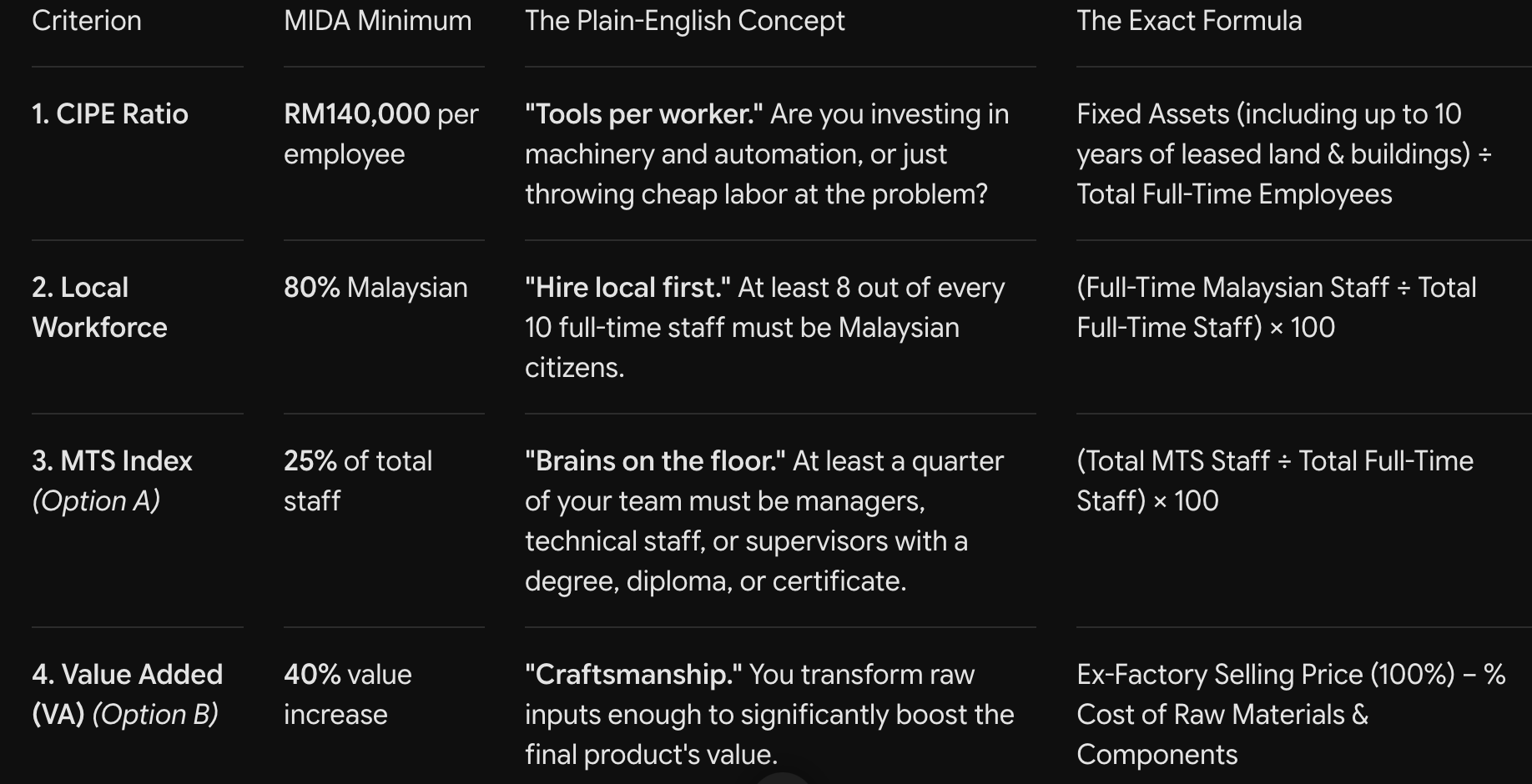
Good news on #3 and #4: You do not have to pass both MTS and Value Added—it is an either/or test. You either hit at least 25% MTS staff OR achieve at least 40% Value Added. On top of these numbers, your project must also align with Malaysia's national economic and social objectives.
Worked Example: Does "MegaBake Sdn Bhd" Pass?
Let's test a fictional commercial bakery planning to hire 80 full-time staff:
Capital Investment: RM8 million in ovens and packaging lines + RM4 million in leased factory premises = RM12 million. (CIPE Math: RM12,000,000 ÷ 80 staff = RM150,000 per employee. Passes the RM140,000 minimum!)
Workforce: 66 Malaysians and 14 foreign workers. (Local Staff Math: 66 ÷ 80 = 82.5% Malaysian. Passes the 80% minimum!)
Value Added vs. MTS: They only have 15 managers/technicians (18.75% MTS—fails Option A). However, they sell each box of pastries at a RM10 ex-factory price, and the flour, butter, and packaging cost RM5 (50% of the price). (Value Added Math: 100% − 50% = 50% Value Added. Passes Option B's 40% minimum!)
Result: MegaBake passes MIDA's core eligibility criteria.
Not sure if your factory hits the CIPE or Value Added numbers? Don't guess before submitting. Reach out for a quick eligibility check to stress-test your figures before MIDA sees them. WhatsApp or Call: 012-6280798 | Email: hktee@barykpartners.com
5. Which Application Type Do You Need?
Not every company applies from scratch. MIDA splits applications into three main scenarios:
New Manufacturing License: For brand-new factories or companies crossing the threshold for the first time.
Expansion or Diversification: For existing license holders who want to add new product lines or expand capacity. Never skip this step—if your license only covers "plastic bottles" and you start making "aluminum cans" without diversification approval, you are breaching your license conditions.
Regularisation: For established companies that quietly crossed the RM2.5 million or 75-employee mark in the past and are currently operating without a license.
6. How to Apply: Step-by-Step via InvestMalaysia
Paper submissions are a thing of the past; MIDA processes applications digitally through the InvestMalaysia portal (investmalaysia.mida.gov.my).
Step 1: Register and Prepare Your Blueprint
Create your company profile on InvestMalaysia. Before filling out a single field, gather your supporting documents—incomplete paperwork is the #1 cause of delays:
SSM Company Registration (current statutory forms and company constitution).
Audited Financial Statements (3 years of audited accounts, or pro-forma accounts if your company is brand new).
Valid Local Council Business License & Tenancy/Land Title.
Factory Floor Layout Plan (drawn with actual dimensions showing machinery placement, storage, and office areas).
Detailed Machinery Schedule (include what each machine does and its specifications—not just its brand name).
Manufacturing Process Flowchart (map every stage from raw material to finished good, including quality control checkpoints).
Manpower Plan (clear breakdown of local vs. foreign workers by department and role).
Step 2: Submit Online & Handle Queries
Submit the application through the portal. MIDA officers will review your numbers and may send follow-up queries or issue specific conditions in their approval.
Step 3: Post-Approval Compliance
Receiving an approval letter is not the finish line. Once approved, you must fulfill the criteria stated in MIDA's Approval Letter and upload your supporting compliance documents within the given timeline so MIDA can issue the final manufacturing license.
7. Why Your License Matters Even More in 2026 (The NIF Connection)
If you are setting up or expanding a factory in Malaysia, your MIDA license is the master key to tax savings.
Effective 1 March 2026, new manufacturing tax incentive applications are evaluated under MIDA's tiered, outcome-based New Incentive Framework (NIF) using the NIA Scorecard. Better project quality and commitments—such as sustainable practices, automation, and high-value local employment—unlock stronger tax incentive packages.
To even enter the door for NIF tax incentives—or to claim import duty and sales tax exemptions on your machinery, equipment, tools and raw materials—holding a valid MIDA Manufacturing License (or an ICA 10 Exemption Letter if you are an SME) is a strict precondition, and you must keep it valid throughout your incentive period.
8. MIDA License vs. Local Council (PBT) License: Don't Confuse Them
One of the most common points of confusion for factory owners is assuming a MIDA license lets them open their doors immediately. It doesn't.
Think of it like opening a restaurant: you need a food-handling certification from the health ministry and a business premise license from your city council. For factories:
MIDA Manufacturing License = Federal permission to manufacture specific products under the ICA 1975.
PBT (Local Council) License = Local permission to operate inside that specific building.
Before signing a factory lease or buying land, verify that:
The land is industrial-zoned.
The building holds a valid Certificate of Completion and Compliance (CCC/CF) with no unapproved extensions.
Your factory meets Department of Environment (DOE) buffer zones and Environmental Impact Assessment (EIA) rules if your process is a prescribed activity.
9. Five Expensive Mistakes That Delay Approval
Submitting Management Accounts Instead of Audited Financials: Unless you are a brand-new company submitting pro-forma projections, MIDA expects audited statements.
Uploading Generic Floor Plans: MIDA verifies that your floor layout shows actual dimensions and machinery locations matching approved building plans.
Listing Machine Brands Without Functions: Writing "3x Siemens Units" tells the MIDA officer nothing. State the machine's actual function and specifications.
Oversimplifying Your Process Flowchart: Leaving out quality control (QC) checkpoints raises red flags about whether your operation is genuine manufacturing.
Operating First and Applying Later: There is no automatic grace period. Operating without a required license is an offence under Section 3(2) of the ICA 1975—carrying a fine of up to RM2,000 or up to 6 months' imprisonment, plus up to RM1,000 for every day the offence continues—and risks disqualifying you from government incentives.
10. Frequently Asked Questions (FAQ)
Does a MIDA manufacturing license expire?
Once issued, your MIDA manufacturing license remains valid as long as you continue meeting the attached conditions (product scope, equity structure, factory location, and employment ratios) and submit your mandatory annual ICA returns on time.
Can I hire foreign workers if I have a MIDA license?
Yes, subject to current government policies and the general 80% Malaysian full-time workforce benchmark. Always check the latest sector-specific policies when preparing your manpower plan.
What if I want to add a new product line later?
You must apply to MIDA for an expansion or diversification approval before manufacturing new products at your licensed premises.
Need Help Securing Your MIDA Manufacturing License Without Delays?
Navigating the InvestMalaysia portal, calculating your CIPE and Value Added ratios, and aligning your PBT council license with 2026 NIF tax incentives can easily cost you months if a single document is missing.
Let our specialists at Baryk Partners handle the heavy lifting for you. We help Malaysian SMEs and foreign investors:
Verify your eligibility (Full MIDA License vs. ICA 10 Exemption Letter)
Audit your financials, floor plans, and machinery schedules before submission
Prepare and submit your application end-to-end on InvestMalaysia
Structure your project to maximize 2026 NIF tax incentives and duty exemptions
Get in touch today for a consultation:
WhatsApp or Call: 012-6280798
Email: hktee@barykpartners.com
