
Malaysia Import Tax: The Ultimate Guide to Duties, SST, and Exemptions
Malaysia Import Tax: The Ultimate Guide to Duties, SST, and Exemptions
Bringing goods into Malaysia places your business squarely within a highly synchronized, digitized regulatory landscape. The Royal Malaysian Customs Department (RMCD) at the border and the Inland Revenue Board (LHDN) managing domestic corporate taxes are directly connected through real-time electronic reporting.
When goods enter the country, they face a compounding matrix of consumption and border taxes. Understanding each levy individually—and how they build upon each other—is essential for accurate cost projection and strict statutory compliance.
1. Import Duty: The Tariff on Entry
Import duty acts as the fundamental entry charge for foreign cargo entering Malaysia's domestic market. The Malaysian government utilizes this tariff to generate public revenue and protect strategic domestic industries from foreign dumping.
Customs authorities determine duty rates based on an item's Harmonized System (HS) Code, which follows the 8-to-10-digit ASEAN Harmonised Tariff Nomenclature (AHTN) codified under the Customs Duties Order (Perintah Duti Kastam - PDK).
Duties fall into three structural categories:
Ad Valorem Duties: The most common form, calculated as a strict percentage of the product’s value. Rates generally range from 0% to 60%, with most industrial equipment and intermediate raw materials falling between 5% and 25%. Many consumer electronics, IT gear, and fashion items hold a 0% rate.
Specific Duties: Fixed monetary sums charged per physical unit of measurement (such as per kilogram or per liter), commonly applied to items like fuel, tobacco, and agricultural goods to shield revenue from market price volatility.
Compound Duties: A blend of both ad valorem and specific tariffs applied to selected protected items.
2. Excise Duty: The Targeted Regulatory Surcharge
Excise duty is a specialized, punitive levy applied to a restricted group of goods. Rather than serving as a blanket trade tax, excise duty deliberately discourages the overconsumption of products deemed detrimental to public health or the environment, or imposes heavy burdens on discretionary luxury assets.
Excise duties apply primarily to:
Motor Vehicles: Completely built-up (CBU) and completely knocked-down (CKD) passenger vehicles face severe excise charges, which scale with engine capacity up to 105% of the vehicle’s assessed value.
Alcoholic Beverages and Tobacco: These items carry compounding specific and ad valorem excise rates subject to periodic upward revisions.
High-Sugar Beverages and E-Cigarettes: The excise net extends to sweetened drinks, liquid nicotine formulations, and vaping products under broader public health initiatives.
3. Sales Tax on Imports (SST): The Single-Stage Consumption Tax
Unlike a multi-stage Value Added Tax (VAT), Malaysia operates a single-stage Sales and Service Tax (SST) under the Sales Tax Act 2018. For imported products, this tax is levied only once: directly at the border by customs officers during physical clearance.
A frequent misconception is assuming that duty-free goods are tax-free. Import duty and sales tax are legally decoupled: an item carrying a 0% import duty rate can still trigger a 5% or 10% SST liability. Because sales tax contains no input tax credit mechanism for downstream wholesalers and retailers, the SST paid at the port represents a permanent, sunk cost.
Imported goods fall into distinct statutory bands:
0% (Exempt): Essential staples, educational literature, pharmaceuticals, and designated medical equipment.
5% (Preferential Rate): Basic building materials, certain everyday food items, and specialized IT hardware components.
10% (Standard Rate): The default rate applied to the majority of imported consumer products, including clothing, cosmetics, household appliances, and electronics.
Policy Update: Luxury Goods and the HVGT
The standalone High Value Goods Tax (HVGT), previously proposed to levy an additional 5% to 10% tax on fine jewelry, luxury watches, and high-end goods, was officially canceled in July 2025 to preserve commercial competitiveness. Instead, luxury consumption remains regulated entirely through the standard SST framework, with high-end luxury items categorized under the 5% or 10% sales tax bands
The Low-Value Goods (LVG) Tax Regime
For cross-border e-commerce, Malaysia enforces the Low-Value Goods (LVG) regime:
Scope: Applies a flat 10% sales tax on imported physical goods valued at RM 500 or less per consignment arriving via air, sea, or land.
Collection Method: Unlike standard imports where tax is assessed upon entry, the LVG tax is calculated strictly on the sale price of the goods (excluding freight and insurance) and collected at checkout by registered foreign or local e-commerce sellers.
Border Treatment: Parcels accompanied by a valid LVG registration number enter without additional border duties or import sales taxes. However, tobacco and intoxicating liquors are explicitly barred from the LVG scheme and remain subject to standard clearance, excise, and full border taxation regardless of transaction size.
4. Valuation and the Compounding Tax Formula
Before calculating your tax obligations, you must establish the statutory tax base: the CIF (Cost, Insurance, and Freight) value.
Malaysia assesses customs valuation under the WTO Valuation Agreement through the Customs (Rules of Valuation) Regulations 1999. The primary valuation standard is the Transaction Value—the total price paid or payable for the goods, augmented by international freight charges and transit insurance to the Malaysian port of discharge.
Adjusting Incoterms: If you purchase goods on terms that exclude transport and insurance (such as FOB, FCA, or EXW), you are legally required to add actual transit and freight documentation to determine the CIF baseline.
Undeclared Insurance: If an importer cannot provide concrete insurance documentation, customs applies a statutory default: insurance is imputed at 1% of the combined FOB price plus freight costs.
Scrutiny on Related-Party Pricing: RMCD reviews transfer pricing closely. If intercompany transactions appear artificially suppressed, customs reserves statutory authority to disregard the invoice and assign values sequentially using identical goods, similar goods, deductive methods, computed methods, or fall-back valuation.
The Compounding Tax Hierarchy
Malaysian border taxes do not sit side by side; they compound sequentially. Each subsequent tax is calculated on an expanded base that includes the levies assessed before it:
Import Duty is calculated directly on the CIF Value.
Excise Duty is calculated on the CIF Value + Assessed Import Duty.
Sales Tax (SST) is calculated on the aggregate of CIF Value + Assessed Import Duty + Assessed Excise Duty.
Step-by-Step Calculation Breakdown
Consider a commercial consignment with an evaluated CIF value of RM 100,000, attracting a 5% Import Duty, 20% Excise Duty, and 10% Sales Tax.

Because taxes compound, even a minor classification error that increases your initial import duty cascades through the excise and sales tax layers, amplifying total landed costs.
5. Strategic Import Duty Exemptions and Relief Facilities
To prevent punitive taxation on intermediate industrial goods and essential production inputs, the Malaysian government maintains comprehensive statutory relief programs managed by RMCD and the Malaysian Investment Development Authority (MIDA).
MIDA Import Duty Exemptions
While sales tax has its own exemption schedules, import duty exemptions are governed separately under Section 14(2) of the Customs Act 1967. This is arguably the most valuable relief available to domestic manufacturers.
Scope of Relief: Approved manufacturers can import machinery, equipment, raw materials, and components with full import duty exemption, provided these inputs are used directly in the approved manufacturing process.
The "Local Non-Availability" Rule: MIDA typically grants this exemption only if the requested machinery or raw materials are not manufactured locally, or if locally produced equivalents fail to meet the required technical quality standards.
Application Process (SPM): Businesses must apply online via the InvestMalaysia portal to secure a MIDA Confirmation Letter (Surat Pengesahan MIDA or SPM) before the goods are imported. Once approved, the digital SPM is integrated with RMCD's clearance system to waive the duties at the port of entry.
Sales Tax Exemption Schedules
Under the Sales Tax (Persons Exempted from Payment of Tax) Order 2018, eligible businesses can bypass border sales taxes:
Schedule A: Covers specific institutions, temporary import regimes, and MIDA-endorsed companies. This includes SST exemptions on machinery and equipment used directly in manufacturing, R&D, private higher education, hotel businesses, and haulage operations. Additionally, certified Aerospace Maintenance, Repair, and Overhaul (MRO) facilities receive exemptions on specialized tools and spare parts.
Schedule B: Grants exemptions on raw material imports to approved manufacturers producing price-controlled, non-taxable finished essentials (such as staple dairy items and pharmaceuticals).
Schedule C: A cornerstone relief mechanism for registered domestic manufacturers. It permits the importation of raw inputs, components, and packaging 100% free of sales tax, provided they are used directly to manufacture taxable finished goods.
Agricultural Relief: Registered manufacturers are exempt from paying Sales Tax on raw ingredients used to formulate livestock feeds, fertilizers, and agricultural pesticides.
Approved Major Exporter Scheme (AMES): High-volume operations exporting at least 80% of their total annual production with turnover exceeding RM 10 million qualify for full sales tax exemption.
Bonded Environments: LMWs and Free Zones
Licensed Manufacturing Warehouses (LMW): Authorized under Section 65/65A of the Customs Act 1967, an LMW operates as a customs-bonded factory. Manufacturers exporting at least 80% of their output can import raw materials without paying import duties or SST.
Free Zones (FZ): Commercial and industrial zones like Port Klang Free Zone (PKFZ) are legally positioned outside the Principal Customs Area (PCA). Goods imported or assembled within an FZ incur no border duties or sales taxes.
The Domestic Clearance Trigger: If finished goods or raw materials exit an LMW or Free Zone into the domestic Malaysian market, the transfer triggers the full assessment of duties and SST via a K9 declaration.
Designated Areas (DA): The duty-free islands of Labuan, Langkawi, Tioman, and Pangkor offer zero-duty status on entry, but moving cargo from these islands into mainland Malaysia is treated as a taxable importation.
6. Agricultural Tariffs: Tariff Rate Quotas (TRQ)
Imports of meat, poultry, dairy, and live animals are regulated jointly by the Malaysian Quarantine and Inspection Services (MAQIS) and the Department of Veterinary Services (DVS).
To protect domestic farming while honoring Free Trade Agreements (such as the CPTPP), Malaysia enforces a Tariff Rate Quotas (TRQ) framework:
In-Quota Shipments: A specific national allocation enters at 0% or substantially discounted duty rates. Quotas are administered via the ePermit system on an open, first-come, first-served basis starting January 1st each year.
Out-of-Quota Shipments: Once the annual quota is exhausted, base tariffs apply immediately. Under CPTPP staging schedules, live poultry faces an out-of-quota tariff starting at 20%, pork carries a 20% base rate, and fluid milk and eggs carry base duties of 40%. Missing the in-quota window can significantly impact commercial feasibility.
7. Audits, Penalties, and Dispute Resolution
RMCD enforces compliance through systematic Post-Clearance Audits (PCA), cross-referencing shipping manifests, foreign exchange payments, and domestic tax records.
Statutory Penalties under the Customs Act 1967
The Customs Act 1967 establishes severe liabilities for regulatory breaches:
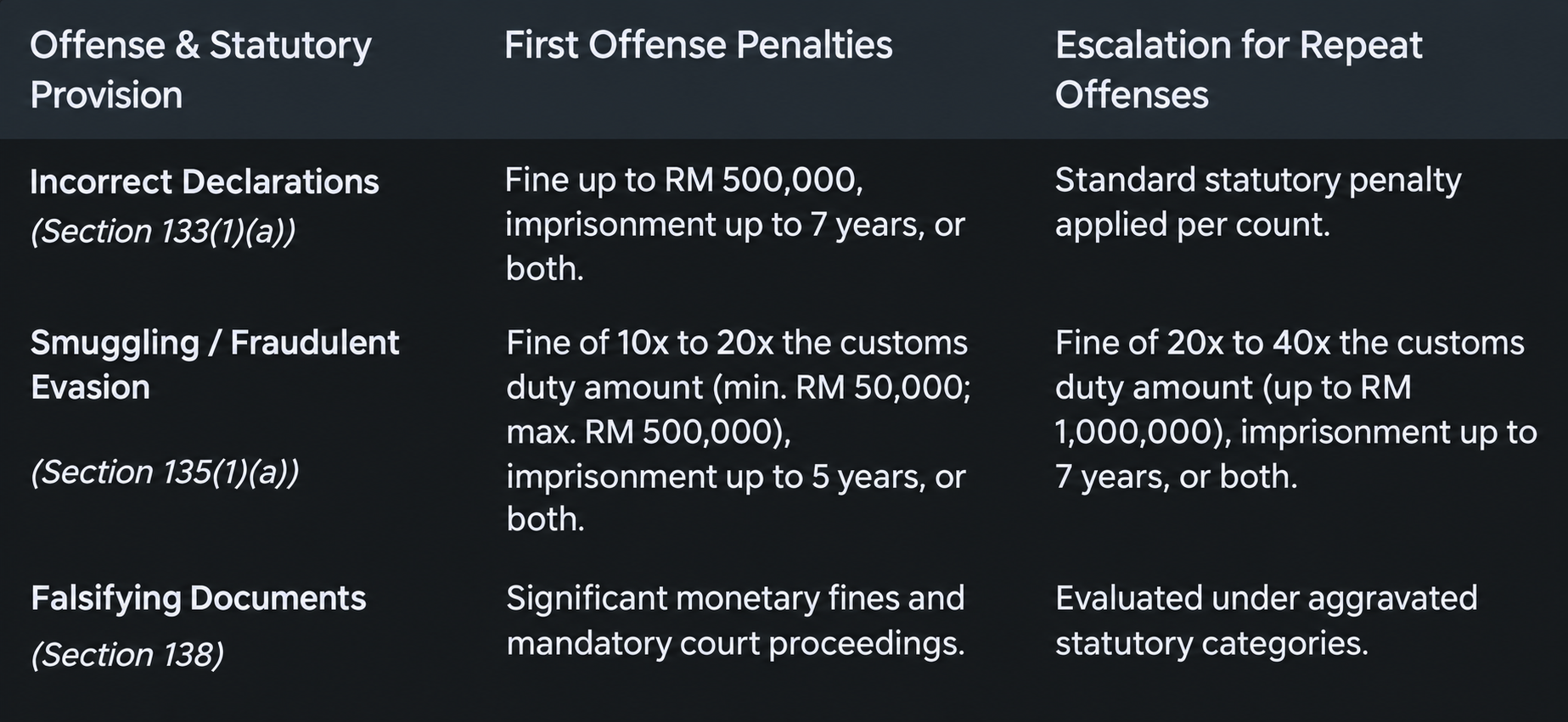
Because offenses under Sections 133 and 135 are classified as "serious offenses" under the AMLA 2001, judicial discretion to grant Good Behaviour Bonds under the Criminal Procedure Code is prohibited. In addition, Section 119A grants courts statutory power to mandate immediate settlement of all unpaid duties upon conviction.
Dispute Resolution
If an importer receives an adverse classification assessment or revaluation notice, they have access to a formal appeal structure:
Director General Review (DG Review): Importers can submit an administrative petition to the Director General of Customs under Subsection 143(1) within 30 days of an adverse determination.
Customs Appeal Tribunal (Tribunal Rayuan Kastam): If the DG Review is rejected, the dispute can be elevated directly to this independent, quasi-judicial body under the Ministry of Finance to resolve technical disputes without immediate High Court litigation.
Audit-Proof Your Imports and Maximize Your Duty Exemptions
Theoretical tax knowledge isn't enough when dealing with customs enforcement on the ground. Led by a former senior RMCD officer with over a decade of frontline regulatory experience, Baryk Partners PLT knows exactly what customs auditors look for and how to structure your operations to eliminate costly penalties or surprise bills of demand.
Whether you need an HS code classification review, assistance securing Import Duty Exemptions for machinery and raw materials, management of Schedule C sales tax exemptions, or proactive audit readiness, we keep your manufacturing operations compliant and cost-effective. Book a confidential consultation with our advisory team to optimize your import tax and duty costs:
📞 Direct Advisory Line: +6012-628 0798
✉️ Email: hktee@barykpartners.com
